
Unless, of course, you’re doing this one thing.
Towards the end of 2025, I launched my own agency, Ardent. One immediate challenge I faced was explaining why we were different. The truth is, my view on the social landscape is a bit… blunt.
I think the industry is infantile.
Brands aren’t to blame; agencies are. For a decade, agencies have used smoke and mirrors to portray social media as a dark art, an impossibly complex maze that only "digital natives" or "experts" can navigate. It’s a convenient fiction.
The result? A stagnant industry failing to push past the invisible wall of attribution. Year after year, the objective is to "drive results," yet those results are often useless when it comes to justifying a budget increase to a CMO, CFO or CEO.
The "Smoke and Mirrors" Trap
Most agencies are content tracking views and likes because they are easy to find and even easier to report. When you ask about true attribution, you’re usually met with a confusing diagram that suggests it’s simply impossible. So why even try?
Here is the reality: Creating an ad that drives likes is fundamentally different from creating an ad that drives intent.
It’s a tale as old as time.
I remember sitting in a room with an agency team that had just delivered a gaming campaign for a major fast-food brand. It was the "moment" of that year. International news picked it up; it won a shelf-full of awards, you could mention it on a sales call and marketers were instantly interested in what you had to say.
I asked the room: “Did we measure how many meals we sold for the brand?”
The usual rationale as to why we hadn’t followed. I was even told the brand "wasn't interested" in sales. Six months later, a new CMO arrived. They were targeted on revenue, not engagement. We lost the account because we couldn't demonstrate how a gaming strategy sold a single food order.
The Air Fryer Paradox
To explain why we need to pivot, I often look at traditional retail. It’s one of the most challenging environments I’ve experienced and taught me that every dollar spent needs to generate X amount of dollars in return if we were to justify our existence. Harsh but true.
Imagine John Lewis runs an in-store campaign for a Ninja Air Fryer. 10,000 customers walk past the display, glance at it, and keep walking. At the end of the day, the manager asks, "How many did we sell?"
If the answer is zero, the campaign would be seen as a failure. We don't celebrate the 10,000 “views”. Yet, in social, we do it every day. Whether it's a TV ad seen by 10 million people or a TikTok seen by 10 million, a view without a map to intent is just a vanity project, a tick box exercise or a short-term celebration. The fact that social hasn’t pushed past this when it yields the most sophisticated tools to do so, is indicative of the challenge I propose.
The 2026 Mandate: Measurement as a North Star
As purse strings tighten and leadership faces increasing pressure to scale, social will face its toughest challenge yet: establishing its importance to the CFO.
So, what is the "one thing" you must do? Fix your measurement framework. At Ardent, we’ve moved past the "post-and-pray" method. We break measurement down into three distinct, actionable pillars that work particularly well on a quality not quantity approach:
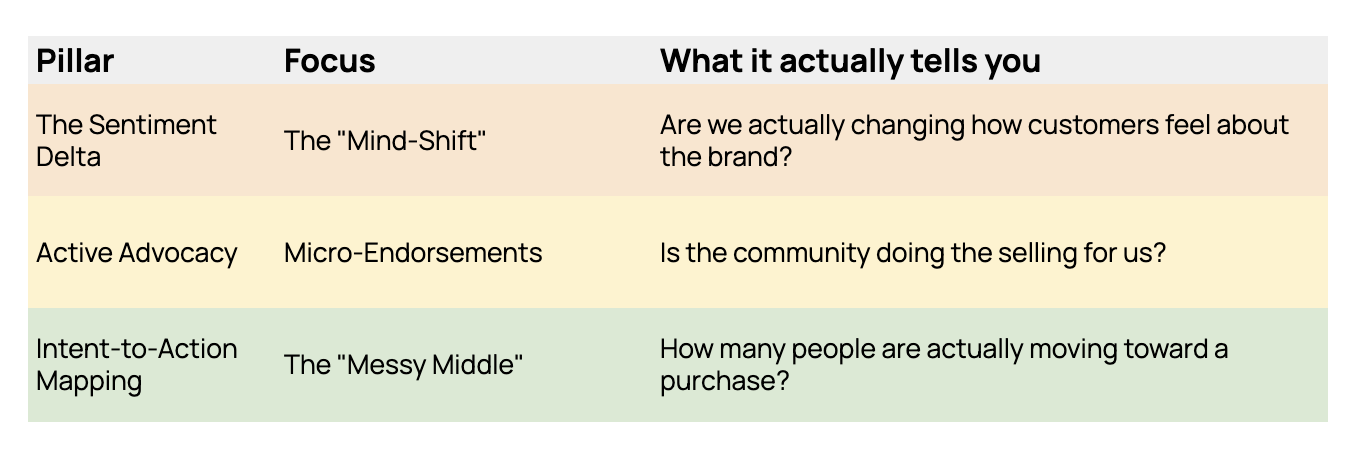
Each stage allows us to track full-funnel performance. Even where direct attribution is notoriously difficult (like high-value, long-consideration purchases), we provide solutions that indicate whether your social & creator strategy is actually impacting your cash flow.
The Bottom Line
In 2026, when the pressure is on, stop settling for easy engagement and views. Double down on intent and advocacy measurement as your North Star. You will quickly find out whether your social experts are set up for your success, or just their own.
Still not sure if your budget is working hard enough? Reach out—I’d be happy to help you find the leaks in your funnel.